⏱ 4 min read
Porsche has officially unveiled a breathtaking new design study that is bound to make waves: the Mission S. Designed to sit directly above the 911 in the lineup as a true successor to the legendary 918 Spyder, it promises to be a mid-engine flagship built specifically to take the fight to Ferrari, McLaren, and Lamborghini.
But unlike ultra-exclusive, limited-run hypercars, Porsche intends for the Mission S to be a full-production vehicle. Combining exclusive insights from Top Gear, Carwow, and Porsche’s official design walkaround with Tobias Sühlmann, here is a complete breakdown of what makes the Mission S the ultimate compilation of Porsche’s greatest hits.
A “Greatest Hits” Exterior Design
According to designer Tobias Sühlmann, the goal was to unite beauty and technology in a car that is “authentic, consequent, and timeless.” The Mission S is an agglomeration of Porsche’s most iconic styling cues, perfectly blended into a dramatic mid-engine proportion.
- The Front End: A super-low, sloping nose reminiscent of the legendary GT1 racing car, combined with vertical panes behind the front wheel arches that scream Carrera GT. Crucially, the “torpedo” fenders sit higher than the bonnet, allowing the driver to see exactly where the front wheels are placed when hitting an apex.
- The Paint and Details: Porsche opted for a highly dynamic, “high-flop” white paint specifically formulated to create deep light and shadow drama across the surfaces. This is contrasted aggressively by exposed carbon fiber on the lower sections and anodized red accents on the door openers and brake calipers.
- The Wheels: Retro “telephone dial” wheels that serve as a brilliant nod to the 928.
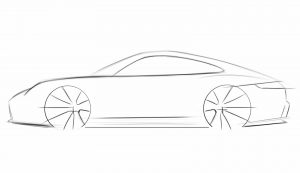
- The Profile: An extended “flyline” pulling the volume backward to emphasize the mid-engine layout, with a sloping roofline that dips underneath the rear spoiler — an obvious hint to the iconic 959.
The “Pebble Section” and the Great Engine Debate
At the rear, you’ll find what Porsche calls the “Pebble Section” — a massive, exposed horizontal fan calling back to the iconic 917 racing cars. While it might look like a retro-inspired cooling solution at first glance, the real question is: what is it cooling?
While Porsche hasn’t officially confirmed the exact powertrain, the exposed fan layout suggests something much larger than a standard flat-6. Rumors point to two incredible configurations:
- A Brand New Flat-8? A flat-8 twin-turbo engine is entirely possible — a format Porsche previously used to win the 1962 French Grand Prix, though they’ve never built a production car with one.
- A 1,000+ HP Hybrid? To compete with the 1,000+ horsepower Ferrari SF90 and Lamborghini Revuelto, Porsche might leverage their 918 Spyder playbook. By pairing an electric motor driving the front axle with a tuned version of the 711 hp twin-turbo flat-6 from the new 911 Turbo S, the Mission S could easily cross the 1,000 horsepower threshold.
The beautifully machined, exposed gear linkage in the center console features a faint “P, R, N, D” embossed on the side — confirming the car will utilize a PDK dual-clutch automatic rather than a manual.
An Ultra-Minimalist, Shape-Shifting Cockpit
Inside, Porsche has ruthlessly “edited back” the technology to ensure the car is focused purely on the driving experience. The dashboard features a clean, Bauhaus-inspired wrap-around line that seamlessly connects the dash to the doors. You won’t find massive digital displays here. Instead, the cabin offers:
- Shape-Shifting Dials: While you get the classic five Porsche instrument dials, they are actually dynamic. When you switch into sportier driving modes, the outer clocks physically push backward while the central rev-counter moves closer to the driver, focusing your attention exactly where it needs to be.
- The “On Your Own” Button: A big red button on the steering wheel that turns off all driver aids and stability systems — leaving it completely up to your own skills.
- BYO Navigation: A clever, pop-out MagSafe mount for your smartphone handles navigation, intentionally ditching the weight and complexity of a built-in infotainment screen.
- Classic Touches: The ignition key slot sits faithfully on the left side of the wheel, and the center console of the design study proudly wears a “001” badge.
Production Timeline and Price
While it’s technically a “design study” for now, Porsche’s CEO has confirmed a new halo supercar based on this mid-engine platform is in development. Don’t expect the production version of the Mission S to go on sale before 2030, with a likely starting price hovering around £300,000 ($380,000+).